Moffat’s Best Monsters, Tricks & Stories (So Far)
Mark McCullough celebrates the best of Steven Moffat so far.
If The Day of the Doctor taught us nothing else, we know that Steven Moffat can throw a good birthday party. It would be my hope that someone would return the favour and give Moffat a birthday to remember. Perhaps a worldwide cinema showing of Moffat’s Darkest Day would not be appropriate (although I’m sure it would be riveting entertainment). Instead the best way to celebrate Moffat is to celebrate he has given us so far. So without further ado, here is my compilation of Moffat’s greats. And if by some miracle he is reading this, I wish the man himself a wonderful day, and many more happy birthdays to come. (Hopefully a few more cracker episodes delivered from his pen too).
Top 5 Moffat Monsters
Most of Moffat’s monsters are certainly memorable (the Silence may want a word with me for saying that). It is quite apparent that he enjoys using things which are already established as fundamental human fears. Because of this his monsters have that added bite that helps them step out from under the shadows of pre-established ones. They can send stone cold shivers down your spine, take your breath away, and leave you questioning if they even exist. He can make you scared of the ordinary, like a child looking its mother, or scare you with nothing at all. So which creatures make the list of his top five?
5. The Empty Child

Coming in fifth place is the Empty Child, not a conventional monster as per se, rather a young boy who died and was resurrected by alien nano-genes. The creature’s goal was simple yet chilling, to find his mum. A lonely young boy capable of immense destruction in a way he can’t control. One touch and you become like him, an utterly terrifying prospect.
4. The Vashta Nerada
 Lots of people are scared of the dark; this is usually classed as an irrational fear, or a phobia. However Moffat would have you believe that it’s not irrational, it’s Vashta Nerada, invisible piranha like creatures who devour your flesh in a matter of seconds. Fear of the unseen, fear of the dark, and fear of death, this concept combines all three with an excellent effect.
3. Fear itself/ the Hiders
 It takes a lot of skill to write a good monster, Moffat undisputedly has this. It takes even more skill to write a great monster, which has fans arguing over whether it really existed. That’s what Moffat manages in Listen where he shows up a gripping premise of the effects of a proposed monster without ever actually showing it. Furthermore each of the occurrences could be explained in another way, leaving the very existence of the Hiders ambiguous. Question: What’s that in the corner of your eye? What’s that footstep coming close but never passing by? Answer: Moffat doing what he is best at.
2. The Weeping Angels

The Weeping Angels, possibly Moffat’s defining monster and the creatures that can only move when you aren’t looking at them. When they do get the chance, they move at lightning pace meaning there is no escaping their grasp. How they attack is only the start of our troubles, it’s the manner of the attack that is particularly frightening, they send you back in time so you will never see anyone who you cared about again. The Angels are a collection of scary concepts which fit together perfectly.
1. The Silence
 What is there to say about the Silence other than that they are my favourite monsters of all time and are easily the best idea brought to life by Moffat’s pen? What is so good about them? Like the Angels and the Vashta Nerada, they play on the fear of the unseen, but that’s not the complete story. The Silence can in fact be seen, it’s just that the person forgets everything about the encounter and that’s where the fun comes in. Schrödinger theorised that you cannot be certain that something exists unless you actively observe it. So there very well could be a Silent controlling Moffat to write the stories we have seen.
Top 5 Moffat Tricks
There was an affectionate term coined on this very site which aptly describes these types of situation. That phrase is ‘Pulling a Moffat’ (credit to Chris) and no that is not a strange nightclub game, it is a description of a narrative technique where the audience are misled and end up missing the obvious answer. Obviously given we have named the technique after him, Moffat is the master at pulling a Moffat. Here’s his five best:
5. “The only water in the forest is the river”

This one was the obvious connection between Melody Pond and River Song, the reversal of the name order and substitution of the words played a large part in the reveal.
4. “Missy, short for Mistress”

Everyone was trying to anticipate the identity of Missy by looking into the tiny details of her character. As it transpired the actual solution was dismissed early on by the fandom for being too obvious by Moffat’s standards.
3. “The Doctor has a secret he will take to the grave. It is discovered”

This time Moffat played with sentence syntax in order to pull the wool over our eyes. The logical assumption from the sentence is that the secret has been discovered when it fact Moffat meant it to be the grave.
2. “The Doctor in a Doctor suit”

The Teselecta twist from The Wedding of River Song is a wee bit divisive to say the least. Despite this there is no denying that it is an incredibly clever way out of the near impossible situation and was one which had been established well in advance of its use here.
1. Two Heads

The Weeping Angels two parter featured Moffat’s greatest illusion. Much like a magician he achieves his trick by distraction; the narrative is so tense that no one is counting the number of heads on the statues. Not on first viewing any way. I can’t watch it without stopping to think, you clever man.
Six Super Steven Stories
For this section of the article I’ve decided to shake things up a bit. I’m not going to rate the episodes against each other, because that will take the focus off the praise of the episodes themselves. Secondly since opinions are very subjective and I know I would leave off episodes that others would see as a crime not to include, I have drafted in the help of two other writers to present a fairer selection of episodes. So Ed Goundrey-Smith and Simon Roberts have offered their thoughts on two episodes each, along with my two.
The Day of the Doctor (Mark)
 Earlier in the article I mentioned that Moffat knew how to throw a party. This episode needs no introduction as Doctor Who’s 50th birthday. But it was so much more than just that, in the eyes of many it is the best episode ever written. For those that this isn’t the case it still is arguably one of their better experiences as a Whovian, in a cinema surrounded by fellow fans (unless you’re boring like me and watched it at home). Moffat treated us with multiple surprises, a return to the Time War and a cameo from each and every Doctor. Furthermore he wrote a wonderful new incarnation of the character and nearly stopped fan’s hearts with a cameo by the newly chosen Twelfth Doctor. The strong narrative was packed with show defining moments the highlight of which undoubtedly being the Never Cruel of Cowardly Scene. A good story wasn’t the only present Moffat and his team delivered a visual feast which was also the first episode of the show to be actively filmed in 3D, quite literally bringing a new dimension to the show.
Listen (Mark)
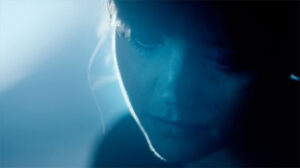 Listen to me when I tell you that is how a standalone episode of Doctor Who should be done. It is paced perfectly with a sense of threat throughout. It’s tense it’s gripping and above all it pure gold in entertainment value. You can certainly tell that Moffat had fun whilst writing this one. Essentially it encompasses everything in some story, it visits the past, the present and the future. It shows all the traits of a strong character piece yet could easily be seen as an adventure of the week. It also showcases defining moments for all three central protagonists of the series. It is indicative of Moffat’s talents as a writer that he made such a massive task look easy and managed to do it so well. It really wasn’t a surprise to see it received so well by the fandom as a whole.
A Christmas Carol (Simon)
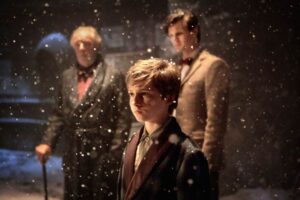 Writing vastly entertaining Christmas themed specials is now a renowned talent of Steven Moffat. But way back in 2010, we were faced with something rather different; a Doctor Who Christmas Special written by someone other than Russell T Davies! No one knew quite what to expect, glimpses from trailers and clips were all we had to go on to get a taste of what this episode would be like. But what emerged on Christmas Day became an instant fan favourite, memorable in the hearts of children and adults alike for bringing us a touching, magical story about an all-too familiar scrounger and, of course, a madman with a blue box. Drawing inspiration from the popular Christmas tale ”A Christmas Carol”, the story is essentially character driven, by the Doctor attempting to change Kazran’s ways in order to save his friend’s lives. By adding sci-fi elements, such as fish that can swim in the fog, and bringing in his iconic ”timey wimey” twists, Steven Moffat takes a classic idea and turns it into something new, refreshing, and unmistakably Doctor Who; a true testament to our head writer’s creative flair.
The Time of the Doctor (Simon)
 Now, despite our head writer’s capacity for producing magical Christmas stories, in 2013 he was faced with a challenge; to write not only another entertaining Christmas special, but to write a satisfying end to the Eleventh Doctor, and many of his era’s dangling arc threads, all in the space of one hour. This would be a challenge to any writer, but Steven Moffat was still able to deliver, in a particularly memorable and spectacular fashion. While managing to give us a touching and memorable swansong to my favourite Doctor, along with tying up many of the plot threads he’d set up throughout the era in an imaginary little bow, he manages to incorporate his iconic Christmas charm through and through, even going as far as to name the town on Trenzalore “Christmas”. This was always going to be a somewhat depressing tale to tell, as is any Doctor departure story, but with Steven Moffat’s gifted penmanship, and some truly mesmerizing acting from Matt and Jenna, The Time of the Doctor comes together to create, in my opinion, the best regeneration story we’ve had so far.
The Girl in the Fireplace (Ed)
 The Girl in the Fireplace is a truly poetic, poignant and bittersweet story. We see a group of Clockwork Droids stalking a lonely Madame de Pompadour throughout 18th century France whilst the Doctor, Rose and Mickey try and stop them from slaughtering her and using her for their spaceship. This is my favourite pre-showrunner Moffat story. He took everything that he does well and wrote a story around it. The Clockwork Droids are one of the best and creepiest designs we’ve seen in the show. I love them and their intricate design is stunning, it really is. The main highlight of the episode is the love story. It seems fitting to call Madame de Pompadour the ‘original’ girl who waited. She often talks about taking ‘the slow path’. Reinette’s relationship with the Doctor symbolises his life perfectly, it’s a truly beautiful analogy. The Doctor, lonely as ever, watching over her life, talking ‘the fast path’ while Reinette has to continue as normal. This is Tennant’s fourth episode in the role, and he’s at his best with a cracking performance, proving that Moffat writes for the Tenth Doctor very well. The rest of the cast do a fantastic job too. With a fine plot, an emotional love story and some stellar monsters, it is hands down one of my favourite Moffat episodes.
The Eleventh Hour (Ed)
 We all know that The Eleventh Hour had a lot to accomplish, and I think it easily achieved everything it needed to. It introduced Matt Smith, who gets off to an absolutely flying start in his first episode (quite literally). It often takes a few weeks for me to get used to the new guy in the starring role, but I was with Matt from fish custard, and I was whooping for joy during the rooftop scene. We also see the introduction of little Amelia Pond. She may not be my favourite companion but her introduction is by far my favourite ever. It’s a truly beautiful piece of storytelling and the fish custard scene always makes me smile. Arthur Darvill makes his first appearance as Rory, and right from the off he’s a really lovely character. The episode has a great plot – It’s perfectly paced with a brilliant threat and it sets up a genius arc. Give Moffat a longer time slot and he will run with it, and this is exactly what he’s done here – every twist, every turn, it’s all spot on. Leadworth provides a great backdrop and it makes a refreshing change to see a country setting instead of London. The Eleventh Hour is an action packed, dramatic, fairy tale of an episode that isn’t just one of my favourite Moffat stories, but one of my favourites of all time
Conclusion
Moffat has given us so much fantastic Who over the course of his tenure, and there is probably so much more still to come. I’ve seen him called many things: the greatest writer the show has had, the master troll, or rather strangely ‘Moffaf’ (you know who you are ;P). But I’m sure one thing we can all agree on is that he deserves thanks for all he has given. So let’s come together to wish him a very happy birthday.
List your own favourites in the comments below!