Doctor Who: Born in the Wilderness – A History of Big Finish (Part 1)
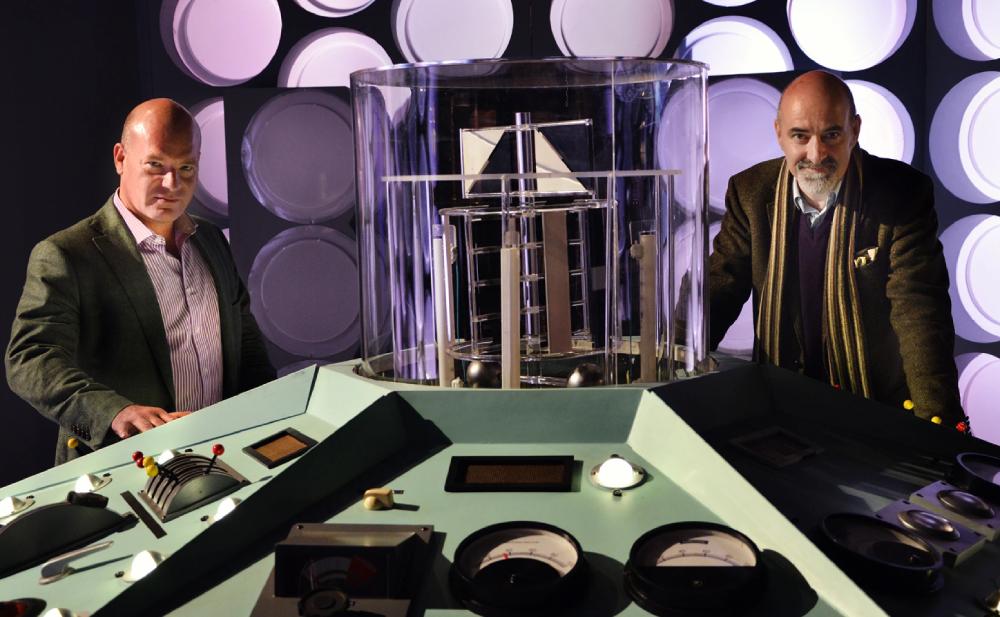
Feature by Gustaff Behr.
Big Finish Productions is a British audio company that has spent nearly three decades doing what Doctor Who fans always wished the television series had time to do: tell more stories. Since forming in 1996, the company has built a reputation for producing high-quality full-cast audio dramas across a range of franchises, but Doctor Who remains its crown jewel.
Over the years, the company has expanded virtually every corner of the Whoniverse, bringing back classic Doctors, creating new companions, launching spin-offs, revisiting abandoned ideas, and weaving together a sprawling continuity of series, crossovers, and original characters. For many fans, Big Finish isn’t just an extension of Doctor Who, it’s the best Doctor Who.
This retrospective explores how that audio empire came about, charting the ranges, spin-offs, experiments, triumphs, and occasional misfires that transformed a small production company into one of the most important custodians of the franchise.
Humble Beginnings
 What a lot of people don’t know is that, in the very beginning, Big Finish couldn’t even make Doctor Who. In the late 1990s, the BBC maintained strict control over the licensing of Doctor Who audio productions, and a broader commercial licence was simply not available to a small start-up. The BBC was already producing its own audio dramas and would later develop online productions for BBCi, some involving Big Finish’s future co-executive producer, Gary Russell.
However, the novel range from Virgin Publishing, The New Adventures, had just ended after the BBC reclaimed the book licence. The character of Bernice Summerfield, created by writer Paul Cornell, was not owned by the BBC. She was the intellectual property of her creator. This meant Big Finish could negotiate a licence directly with Paul Cornell, which was a far simpler and cheaper deal than trying to secure the Doctor Who licence from the BBC.
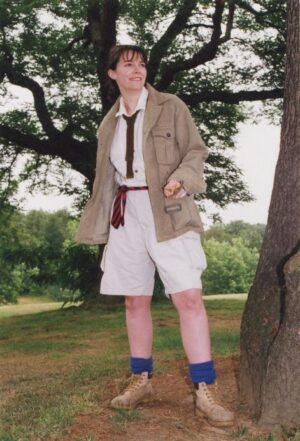
Thus, Big Finish Productions’ first series was created. Bernice Summerfield (17 seasons, 75 episodes, 4 specials) followed Bernice, an archaeologist from the 26th century, known for her sharp wit, adventurous spirit, and spirited drinking habits.
Actress Lisa Bowerman was cast as Bernice Summerfield, a role she has continued to play in numerous audio dramas ever since. She’s often referred to as ‘The First Lady of Big Finish’, a title well-deserved.
The ‘Who’ in Doctor Who
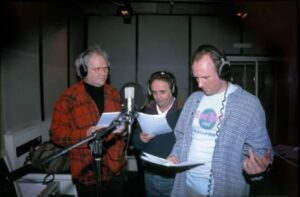
Bernice Summerfield proved full-cast dramas could work on audio, so Big Finish eventually got permission to produce Doctor Who. The Sirens of Time featured the Fifth Doctor, Peter Davison, the Sixth Doctor, Colin Baker, and the Seventh Doctor, Sylvester McCoy, appearing together. This title launched Big Finish’s principal Doctor Who range, later known as The Monthly Adventures, which ultimately ran for 275 releases.
These stories typically ran for approximately two to three hours and featured the Fifth, Sixth and Seventh Doctors, with the Eighth Doctor eventually joining them. The range rotated between the Doctors to keep things fresh. Some stories were standalone adventures, while others formed part of larger, multi-year story arcs.
But it was the year 2000 that served as the true testing ground for the company’s format.
 Some actors, such as Janet Fielding and Tom Baker, were still distancing themselves from Doctor Who at the time, but this gave Big Finish an excellent opportunity to revisit comparatively underexplored TARDIS teams, such as the Fifth Doctor and Nyssa or the Fifth Doctor and Peri Brown. Colin Baker’s Sixth Doctor, however, had arguably the most unusual, experimental and difficult mountain to climb during these early years. At the time, the Sixth Doctor was still considered the most disliked incarnation, with both Peri and Mel receiving similarly mixed receptions among fans. Big Finish hedged its bets, though, by introducing an entirely new companion created specifically for audio: Dr Evelyn Smythe. At the same time, the company ventured into the comic-strip continuity with The Holy Terror, pairing the Doctor with the shape-shifting Whifferdil detective Frobisher.
The Doctor from America
When the BBC co-produced the 1996 TV Movie with Universal Studios, the rights surrounding the production were divided between several parties. The BBC retained control of the Doctor and many established elements of the series, while the new characters and certain design elements created for the film were tied up in separate rights arrangements.
 This meant that Big Finish could add Paul McGann to the Monthly Range, but it couldn’t use his onscreen companions, Grace Holloway and Chang Lee. Fortunately, the company had just proven with Evelyn Smythe that original companions could work so it created Charley Pollard, a bold, adventurous Edwardian heroine who met the Doctor aboard the R101 airship in 1930.
Perhaps even more significant in 2001 was Big Finish’s growing embrace of long-form storytelling. Although the Classic Series had experimented with season-long quests, linked trilogies and recurring villains, Big Finish began developing character and story arcs that stretched across several years of releases. The most notable example was Charley’s very existence: the Eighth Doctor had saved her life in Storm Warning, despite her being destined to die, creating a paradox that would have consequences for years to come.
Elsewhere, Project: Twilight introduced Nimrod and the Forge, a secretive and morally dubious organisation that effectively served as Big Finish’s answer to what Torchwood would later become, which would involve several multi-year story arcs involving the Sixth and Seventh Doctors.
2001 also saw the launch of one of the company’s first major spin-offs, Dalek Empire (4 seasons, 18 episodes), which placed the Daleks as the main characters as they campaigned across space and time for conquest.
Building Their Own Universe
Now that Big Finish had a firm grasp of just how big its Doctor Who sandbox was, it was time to fill it with sand. Unlike Janet Fielding and Tom Baker, Elisabeth Sladen was willing to return in 2002, which resulted in Sarah Jane Smith (2 seasons, 9 episodes) being launched years before the character reunited with the Tenth Doctor in “School Reunion”. Rather than pair her with one of the later Doctors, the series explored what became of her after the Doctor left her on Earth. Basically, it was a ‘what happened to Sarah Jane before meeting Maria and Luke?’ scenario. Although K9 was acknowledged as existing within the continuity, his absence was explained by the robot dog having fallen into disrepair, an idea later echoed in “School Reunion”, where Sarah Jane revealed that K9 Mark III had stopped working years earlier.
It was also around this time that Big Finish began experimenting with ‘cross-Doctor’ stories. The Excelis mini-series was quite important for many of the company’s future productions because, rather than telling a single story arc with one Doctor, this mini-saga spanned multiple incarnations. What made the project unusual was that none of the Doctors would never meet one another. Instead, the stories were linked by recurring characters. This cross-Doctor story concept would become a recurring device in later Big Finish productions.
 Another issue Big Finish faced was that, while the company effectively had four active Doctors on the roster and a growing pool of companions and original characters, it still had no access to William Hartnell, Patrick Troughton or Jon Pertwee, for obvious reasons. Rather than treating that as a limitation, Big Finish responded to it in a very different way. The company asked: What if the Doctor wasn’t fixed by canon at all?
That idea launched Unbound (4 seasons, 14 episodes, 1 Special), an anthology range built entirely around alternate realities. Instead of continuing established continuity, each story explored a different version of history: What if the Doctor had never left Gallifrey? What if UNIT never existed? What if the Valeyard had won?
A few months later, on 26 September 2003, the BBC announced that Doctor Who would return as an ongoing television series, sixteen years after the end of its original run. This announcement would have major implications for Big Finish, but more on that next time.