
The Future of Doctor Who in the Meta Age: Can the Show Win Back Its Audience?
Feature article by Zachary Schulman.
Humour can be incredibly healthy. Recently, the former series lead Ncuti Gatwa publicly came to terms with the impact of the Disney run of Doctor Who while hosting Saturday Night Live UK. To recognize oneself through the eyes of others by bravely sharing vulnerability is to be commended. Not everyone has the courage to make fun of themselves. Whether humour smarts or is acceptable, there’s some truth to it. Doctor Who isn’t at its best right now, whether its success is measured by the number of viewers, by audience appreciation, or even by its reputation among non-viewers.
Certainly, the humour of last year’s sketch “It Died of Cringe” from the BBC Radio 4 comedy series Dead Ringers hits because it’s true. That Doctor Who remains a haven for colourful communities is a victory worth being proud of, and there are many ways in which such a culture of acceptance can be sustainable. However, what Dead Ringers nails with a mallet is that much of what has happened is “for clicks”, not for love. The comedy sketch makes it abundantly clear that viewers and even non-viewers of Doctor Who can understand when a display of love is just performative love. Considering that the 2026 Christmas special may no longer be happening because there is still no Sixteenth Doctor, the urgency to solve the show’s popularity crisis seems dire. In order to imagine what the future of the show will be—what it should be—we must examine what’s been happening. And this is where things get meta.
The Meta Age
Doctor Who has evidently had difficulty transitioning into an age when discussions of meta have become more popular than ever. Don’t worry, this isn’t about the dominion of Meta Platforms, Inc., and their product Facebook. Here, meta refers to something far more wholesome than big tech companies: We’re living in the Meta Age of Comic Books. While meta storytelling in character-driven media certainly didn’t begin this millennium, the collective imaginary is now saturated with self-awareness.
While the Golden, Silver, and Bronze Ages of Comic Books are widely recognized, the “Modern Age” of Comic Books hasn’t been updated in decades. Doctor Who had been created during the Silver Age of Comics, and naturally had participated in and been impacted by the comic-book genre with the publication of stories in TV Comic and TV Century 21 beginning in the mid-1960s. In their autobiography Supergods, Grant Morrison names the age succeeding the Bronze Age as the Dark Age. Though unspecified in their autobiography, the Dark Age is thematically bookended by cultural milestones such as Watchmen (1986) and Batman Beyond (1999), following a model of roughly 15 years per age. Among their numerous accomplishments, Grant Morrison has also written comics for Doctor Who and has written Daleks—“Metaleks”—into their run of Superman’s Action Comics. The Dark Age of comics is also when Classic Who (1963-1989) had been cancelled, and the infamous Wilderness Years had begun.
In the year 2000, a film titled X-Men changed everything. Superhero movies became “cool” and comic books were revived from a decade-long slump in sales that had Marvel selling the movie rights of their characters to hungry studios. Aptly, the Dark Age is succeeded by what Morrison calls the Renaissance, the genre’s rebirth. Doctor Who had been revived in 2005, during the same Renaissance. Doctor Who didn’t end, as it had survived in other media, and new stories continued to expand the rich world we today call the Whoniverse.
Beyond a prescriptive notion that ages of comic books end every 15 years or so, perhaps the best thematic bookend for the Renaissance is the cultural milestone Avengers: Endgame (2019), which concluded the Marvel Cinematic Universe’s narrative trajectory that began in the 2000s. In a so-called Meta Age of Comics, one could claim that the current era began earlier with the success of Deadpool (2016), a film showcasing a comic-book character that many of us never expected to become a multibillion-pound franchise. The character is absurdly and captivatingly meta, exhibiting a power of perception far beyond what most of our favourite superheroes are capable of. In the 2016 Doctor Who Christmas special “The Return of Doctor Mysterio”, then-showrunner Steven Moffat makes an excellent case for why the Doctor should be regarded as a superhero the likes of Superman and Spider-Man. The Twelfth Doctor certainly has fun playing with the idea that he could be a comic-book superhero.
For over 60 years, the Doctor has been published in comic-book stories, so the connection between Doctor Who and comics is self-evident. The flavours of Doctor Who stories also take their cues from a larger environment of storytelling. Across the eras of Classic Who and New Who, audiences had widely accepted the Doctor as an extraordinary character in a fictional universe. The fourth wall occasionally gets broken in delightful ways and the audience is nonetheless immersed in a wonderful world of stories. However, in the Disney era the Doctor is written to be immeasurably more aware of his own existence. The Doctor knows that he’s a character, or rather that his life is a story observable from outside of his universal perspective. The “power creep” is hyperbolic.
Know Thyself
Back in 2023, before the first Disney special “The Star Beast” aired for the 60th anniversary, the Children in Need special “Destination: Skaro” set the tone for the new era. In a traditionally acceptable meta moment, the Doctor recognizes, “Wait a minute, do you mean this is the ‘Genesis of the Daleks’?” The comedic genre change to the Daleks’ formerly sci-fi/horror origins, accompanied by playful jazz, is certainly more appropriate for the young target audience who is being protected from processing genocidal trauma. A momentous change to the character occurs as the Doctor continues, “Nononono, stop it! Look . . . I was never ever here! Never! The timelines and canon are rupturing.” What makes this moment unique is that the Doctor proclaims to know the canon of his own story. If the Doctor said “The timelines are rupturing” it would be par for the course. But “canon” has its own mythological weight, and subsequent Disney Who stories reinforce the Doctor’s new powers of perception.
Beyond the Fourteenth Doctor being a more introspective incarnation capable of making healthy, sustainable life choices—exemplified by his living with the Nobles—the writing of the Disney era never surrenders these dangerous mythical powers of perception. In “The Devil’s Chord”, Maestro ensnares Ruby Sunday with tangible music, and the Fifteenth Doctor comments, “I thought that was non-diegetic.” Non-diegetic sounds or music are audible to the audience but not to the characters, as opposed to diegetic sounds or music, which the characters can hear. Here, the Fifteenth Doctor demonstrates Meta Age knowledge that he is indeed a character because he’s thinking about how we, the audience, are paying attention to his adventures.
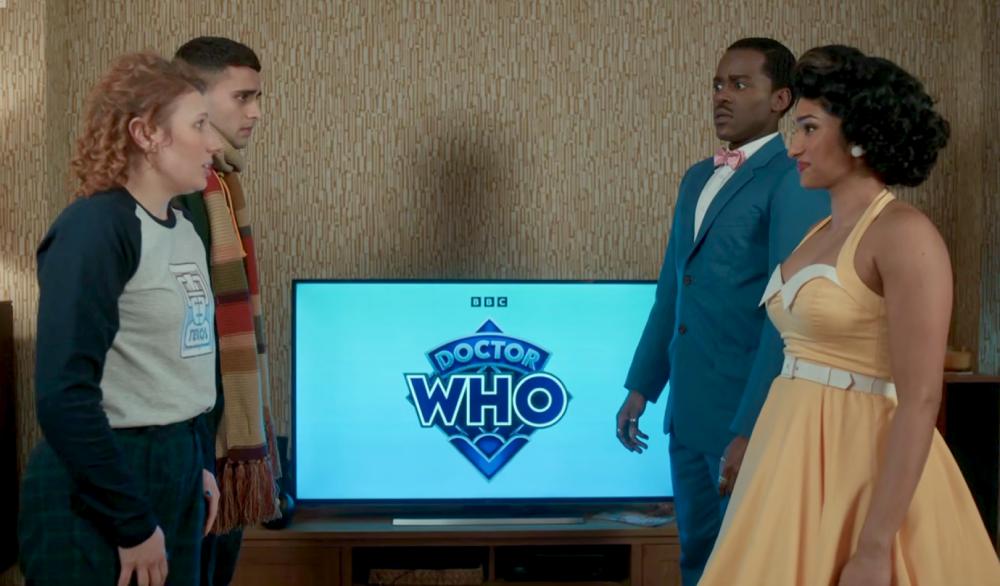
Disappointingly, such great power is not used responsibly. In “Lux”, the Doctor and his companion break the fourth wall itself and find a dimension where they are characters in a television programme called Doctor Who, and it isn’t funny. The Doctor meets three of his fans, Lizzie, Hassan, and Robyn. While there’s a playful (albeit conceited) exchange when the Fifteenth Doctor thinks that his incarnation’s adventures are the best ones, the scene goes into depressing territory. After being called “so annoying”, Lizzie is written to confess, “No, we are a bit annoying. I know that. I’m wasting your time because [. . .] We don’t exist. [. . .] We’re the kind of characters that don’t have surnames. We’re just part of the trap, so that creature can play with your minds.” The misuse of Murray Gold’s triumphant score, composed for the Eleventh Doctor, pushes an inappropriate emotional framing of the scene as the Fifteenth Doctor smiles and then cries in acceptance that these devout, loving humans will blink out of existence without him. Lizzie bargains, “But maybe just now and then you can think of us. Then we might live on just a little bit.”
Many of us fans, or Whovians, fear being alienated for who we are. Critically, the scene isn’t intended to be comedic. Neither the writing nor the melodramatic markers indicate a spirit of humour. While the actors playing Lizzie, Hassan, and Robyn clearly communicate their characters’ love of Doctor Who, the show receives their attention at their expense. Compare this portrayal of the fanbase with Oswin Osgood, a quirky and inspiring human being who we are made to feel actually has agency and a legacy all her own. Without Doctor Who we disappear? Deconstructing one’s audience at the expense of our vulnerabilities isn’t love, nor is it tough love. It’s something much less wholesome altogether.
In the Future
The survival of Doctor Who in the Meta Age is contingent on creating allies, not alienating them. Anger may be entertaining, but if it drives viewing numbers down then it’s clearly not widely engaging audiences. Having made the pilgrimage to Chicago TARDIS in November 2025, I can see the profound good that the colourful narratives showcased throughout the revival have done to empower Whovians—be it moving beyond the suppressing paradigm of previous generations’ expectations on treating mental health, or embracing just how many queer ways someone can be a good human. The vast majority of the Doctor Who experience is welcoming and nurturing. Many of us are continually drawn to the Doctor for their overall experience as an alien and how ironically relatable that is in a world populated by billions of our own kind.
In order to ensure that the Whoniverse keeps building bridges, it would be worthwhile to consider what mediums beyond television that Doctor Who has been successful in. While I couldn’t possibly speak to the revenue of Doctor Who stories in mediums other than television, I believe it’s fair to say that audience appreciation for non-television Who is extremely high. The diverse pool of perspectives that contribute various visions of the Whoniverse keep the storytelling ecosystem vibrant and enduring. I myself have quite a way to go before I catch up with almost all of the Titan Comics series, which have sustained my engagement with the franchise for years. Doctor Who Magazine’s own Meta Age story “Liberation of the Daleks” masterfully moves the canon forward without rewriting the past. And certainly, we mustn’t forget the foundational role that Big Finish has played, and will continue to play, in keeping Doctor Who alive. I imagine that the revival in 2005 after the Wilderness Years may not have been possible if not for all the loving work from Big Finish.
Many would agree that Doctor Who at its best is a labour of love, not a platform. I have faith that love will keep Doctor Who alive so that “the story never ends.” In such an age of storytelling, audiences are more than capable of reading between the lines and evaluating content for quality. It’s better to be quietly meta and recognize what’s been happening than to rush self-awareness “for clicks.” The show’s survival depends on it.