Doctor Who and the Curse of Fatal Funds: How RTD2 Blew the Budget
Doctor Who feature by Gustaff Behr.

How did one of television’s longest-running shows end up spending big, shouting louder, and still losing its biggest backer? That’s what we’re here to unpack today.
Let’s look at what went wrong with the RTD2 era budget, how to fix it, and why they’ll probably ignore everything after the next full stop. Ready? First item on the list:
Excess Spending on Useless Scenes

Let’s use “Space Babies” to explain…
Right out of the gate, we’re treated to a sequence where the Doctor takes Ruby to prehistoric Earth—whoops— she turns into a lizard person. It’s colourful, it’s loud, but also, utterly pointless. The gag contributes nothing to the story. It’s there because someone, somewhere, thought, ‘Wouldn’t it look cool?’
And it does look cool. It also looks expensive. But it’s just a gag about the dangers of time travel, the sort of thing that could have been done anywhere else in the series for a fraction of the cost. In fact, Russell T Davies already did this scene back in 2005 during “The End of the World”.
Let’s ballpark to see how much each of those scenes might have cost the production of Doctor Who, using standard UK-industry rates and making some assumptions.
For “Space Babies”:
- Set Build & Dressing: £75,000: Studio jungle with props, practical plants, and dressing
- Studio / Stage Hire: £6,000: Approx. 2 days in controlled space
- Crew & Labour (Shoot Days): £50,000: Multiple days, heavy setup and teardown
- Lighting, Camera & Grip: £15,000: Complex exterior lighting rig
- VFX / CG Compositing: £40,000: Digital sky, volcano, matte work
- Misc. (Transport, Catering, etc.): £5,000
Approximate Total: £191,000
For “The End of the World”:
- Studio / Stage Hire: £2,000: 1 day in studio
- Crew & Labour (Shoot Days): £20,000: Standard single-day unit
- Lighting, Camera & Grip: £3,000: Minor adjustments to set.
- VFX / CG Compositing: £2,000: Minimal, mostly color grading
- Misc. (Transport, Catering, etc.): £3,000
Approximate Total: £30,000
The Ninth Doctor’s scene, by contrast, achieves the same narrative purpose, showing off the TARDIS’s reach and giving the companion her “first trip” moment for a fraction of the cost. It’s not that the “Space Babies” team did anything wrong technically, it’s that they did everything expensively.
The Bloat of Modern Doctor Who
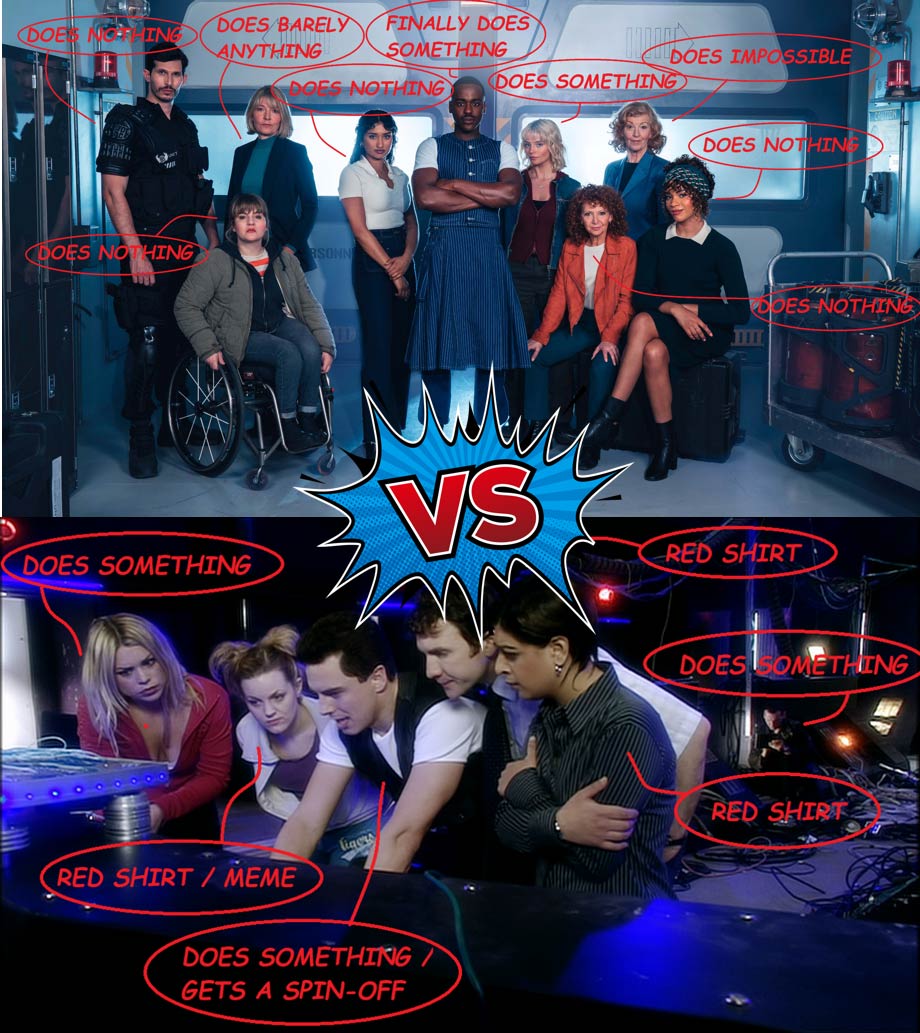
One of the quietest but costliest problems with Modern Doctor Who is its obsession with overstaffing every episode. Scenes that should center on the Doctor and their companion now look like corporate conference calls. UNIT soldiers, scientists, consultants, and legacy characters all crowd the frame, repeating exposition, nodding solemnly, or, in some cases, literally holding the door open.
Every extra face means makeup, wardrobe, transport, catering, and a day’s pay. “The Reality War” is a perfect example: Belinda, Anita, Kate, Ibrahim, Melanie, Shirley, Carla, Winnie, The Vlinx, Rose, and Cherry…eleven main characters, ten supporting, plus the nameless background operatives staring heroically at computer screens.
Contrast that with “The Parting of Ways”. Six main characters. Six side or supporting ones. Both episodes use recurring sets (the UNIT base and Satellite Five) but “The Parting of Ways” wrings meaning from intimacy, while “The Reality War” mistakes headcount for scale.
Now, let’s talk money! Using UK Equity union baselines and a standard twelve-day shoot, “The Reality War” racks up an estimated £340,000 in performer costs alone. “The Parting of Ways”? Roughly £194,000 (or £110,000 in 2004 currency). Twenty actors versus twelve. Same screen time, half the purpose. Bear in mind, these are not true values, but base industry estimates, assuming that both stories were made in 2025, which they weren’t, but hopefully you understand the difference.
“The Parting of Ways” earned its emotional heft with a fraction of the people and three times the focus. “The Reality War”, on the other hand, pays through the nose for redundancy. A dozen characters stand around a soundstage built to look cinematic, while only two of them matter. Anita, whose defining job is to hold the door, represents real production cost: a full day’s wage, transport, costume, make-up, catering, repeated across multiple shooting days.
So, remember kids: when in doubt, less really is more. Otherwise, you might find yourself explaining to Mickey why your 62-year-old time-travel show managed to spend $200 million on 26 episodes…and still couldn’t afford a decent script.
Inadequate use of Cheap/Filler Episodes
Now, let’s talk about the art of the cheap episode. It’s the clever story that saves money so you can blow something up later. “Love & Monsters” did it with humour and location shooting with practical effects, “Blink” made television history with one practical monster and a handful of actors, “Midnight” kept everyone trapped in one room and used nothing but dialogue to make you afraid of a children’s game.
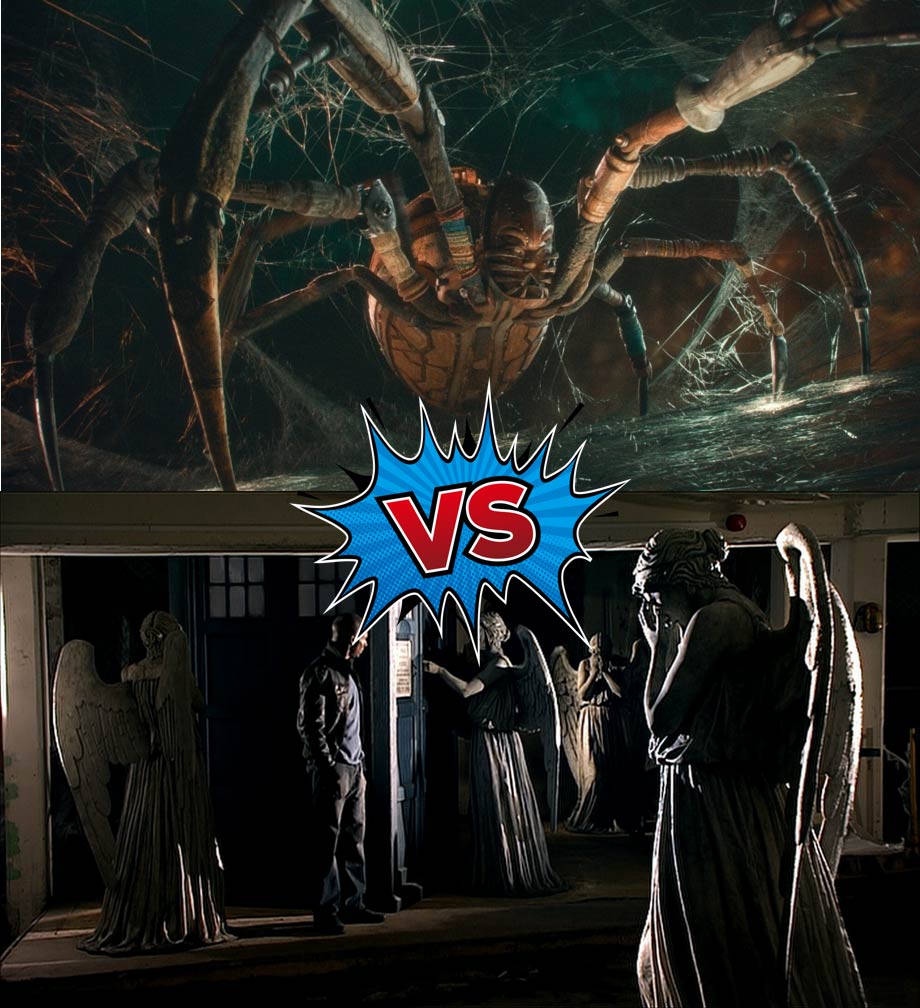
But somewhere along the way, Modern Doctor Who forgot the assignment. You’d think “Boom” and “The Story & the Engine” were your bottle episodes. After all, small casts, limited sets, but “Boom” built a massive new set for two scenes that could’ve been filmed anywhere else or cut entirely, while “The Story & the Engine” went for broke with unnecessary CGI in the form of a big spider-god. Instead of being smart with the budget, they decided to see how much money they could burn before the credits rolled.
Here’s the kicker: Modern Who isn’t thirteen episodes anymore, it’s eight. That means no room for filler, and yet, somehow, we’re drowning in it. In the old days, you could afford to wander. Now, every episode has to count. But half of Series 14 doesn’t.
Let’s run the numbers!
- Series 14: Only “Space Babies,” “The Legend of Ruby Sunday,” and “Empire of Death” move the story forward.
- Series 15: “The Robot Revolution,” “Lucky Day,” “The Interstellar Song Contest” (for one bi-generation scene only), “Wish World,” and “The Reality War.”
Everything else? Gorgeous to look at, but utterly disposable. Beautiful, expensive bridges between undercooked finales.
And why waste those precious slots on disconnected side-quests when you could use them to build something? Imagine a villain-focused mid-season episode which gives us a glimpse into the Rani’s plan for Omega, or a Susan episode exploring her history leading up to her reunion with the Doctor. That’s how you turn pacing into payoff: by making the connective tissue of the story matter as much as the finale itself.
So next time you’re tempted to blow a cheap, filler episode budget on fancy CGI or custom-built trenches, remember you don’t have thirteen hours to fill anymore. You’ve got eight. Make every one of them count.
Negative Marketing
Negative marketing is the easiest mistake to avoid and somehow the hardest lesson to learn. It costs nothing, yet numerous productions end up paying through the nose. In reality, all you have to do is keep your mouth shut.
See, in 2025, you’re free to have whatever opinion you like. But here’s the catch: creators now depend on their fans far more than fans depend on creators. There’s more entertainment than ever, and if you tell your audience they’re ‘grumpy old’ dinosaurs or to ‘go touch grass’ etc, they’ll simply find something else to watch. The fandom doesn’t need Doctor Who to survive, Doctor Who needs the fandom.
If the BBC pulled the plug tomorrow, fans would still have over 2,400 hours (and counting) of Big Finish audios. That’s more than five times the length of Classic and New Who combined. The Whoniverse would keep spinning, with or without Russell T Davies or the BBC’s blessing.
So, here’s a quick tip for all the future showrunners out there: Don’t preach to your audience. Don’t tell them what to think, who to vote for, or how enlightened they should be. Don’t call them names while you’re representing the brand. Because right now, Doctor Who needs everyone: the casual viewers, the diehards, the skeptics, the cranky YouTubers, even the so-called “wrong thinkers.” You need them all to talk about the show (positively), share it, meme it, and keep it alive.
BBC and RTD, you just lost a partnership with one of the biggest studios on the planet. Maybe it’s time to stop lecturing your fans and start listening to them.
And for heaven’s sake: Spend Less, Create More.