Matt Smith: My Doctor – Part 3: Series 6
Guest contributors K-Ci Williams and Luke Gwalchmai continue their Matt Smith retrospective.

The time is most definitely approaching, so we shall press on by taking a look back at Series 6. Following a stunning first series, Matt Smith returned for another strong 13 episodes of his second series. Let’s take a look at one key aspect we enjoyed from each story…
The Impossible Astronaut/Day of the Moon
 What I love the most about this series is that we start from the end. Almost straight away, we see the Doctor die. What’s noticeable is that when the Astronaut and old Canton turn up, the only person who isn’t surprised is the Doctor, he knows exactly what’s going to happen, and he knows everything that we will learn in the series. He also knows that this is all a lie and he’s faking his own death! The look on the Doctor’s face as he sees Canton is a look of sadness and resignation; he knows he must die here. Well, make it look like he’s dying to the Silence and his best friends! It’s brilliantly convincing from Matt Smith.
The Curse of the Black Spot
 Matt Smith brings a jocular mood to an otherwise alarming situation in this story, where he portrays a Doctor who is clearly enjoying his time on board a Siren-ridden ship despite it possibly signalling the end for the people around him. “Yo ho ho! Or does nobody actually say that?” This is where you remember that the Doctor is comedic, regardless of how dark the stories become. A key moment is when he’ll walk the plank; he takes a comical side to the situation, giving Amy enough time to shout BOO! Smith performs masterfully, showing a Doctor that is youthful in his old age, bringing a light sense to sombre situations, and being an absolute delight to watch on screen.
The Doctor’s Wife
“Please, I don’t want you to”
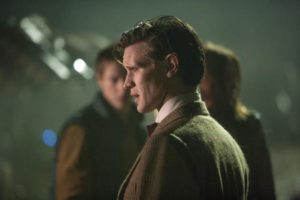 This is one of the most emotional episodes of Matt’s era, especially when he has to say goodbye to the TARDIS (Idris) and both he and Suranne Jones are on top form here. They both really have you emotionally invested in these characters. It’s one of the first times that we see the Eleventh Doctor cry, and it’s so emotional; the Doctor is someone who, on the whole, likes to keep his feelings inside. But on some occasions he lets them pour out, and we see his most vulnerable side, he’s loved being able to talk with the TARDIS and he never wanted it to end. And he was heartbroken when it did.
The Rebel Flesh/The Almost People
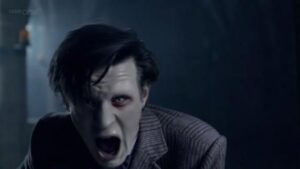 Get ready for it: the key moment of this story is of course, having Matt Smith act off himself. The concept of the Flesh allowed Smith to perform outside the usual boundaries. Unfortunately, there’s no space to flesh out the whole conversation back and forth between the two Doctors, so I suggest that, if you’re feeling like letting go of Matt will be difficult, go back and watch the Ganger scenes, they’re ingenious pieces of television. Additionally, there are small links to the past in the script: there’s talk of Jelly Babies; reversing the polarity of the neutron flow; Cybermats, all woven into Smith’s charming delivery. Plus it sets us up nicely with a shocking twist for the next story…
A Good Man Goes to War
 To me, this is the first episode where we really see the darker side of the Eleventh Doctor. This side surfaces when he brands Colonel Manton “Colonel Runaway”, as well as blowing up a whole Cyber Legion just to prove his point. His anger in this scene seems to affect Madame Kovarian when he tells her that “Good men don’t need rules… today is not the day to find out why I have so many”. This is the Doctor saying that if he didn’t purposefully stop his anger from boiling over, it could not be stopped by anyone in his way. It shows how dangerous the Doctor would be if he let his darker side take over him. This scene is so powerful and you see just how unstable the Doctor is.
Let’s Kill Hitler
 The Doctor is near death in this story, a tale that I enjoyed for the most part due to the regeneration of Mels into River Song (while some feel this was overdone, I completely loved it). However, Matt proves that in the mid-series premiere of his second year as the Doctor; he’s still got the power. He’s as auspicious as ever, utterly flamboyant in his qualities and a definite delight in the role. For the Doctor, there’s a key moment where he crawls to the TARDIS, with all of his commitment – to save the Ponds (meanwhile River’s just sitting down without a care in the world) – and never gives up. Matt can play two opposite ends of the spectrum effortlessly and transitions between light and funny to dark and serious upon the need.
Night Terrors
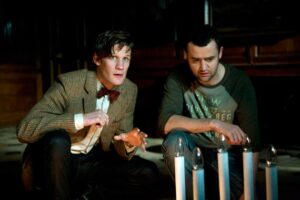 The highlight of this story is the soft touch Matt Smith takes when playing the Doctor. Children always fascinate him, and he strives to help every time. Here, his seriousness is toned down to allow space for his inner child; something Matt portrays wonderfully. It’s nice to see an otherwise dark and eerie episode sprinkled with light acting, because it makes for a contrast in mood throughout the piece, taking the audience for multiple rollercoaster rides. I don’t think this is a bad story, but it’s not one of my favourites (they’re usually all by Moffat anyway). However, Gatiss is able to assemble a script that allows Matt and the cast to play against wooden dolls; creepy wooden dolls, I might add. So all in all, still a great performance from Matt Smith.
The Girl Who Waited
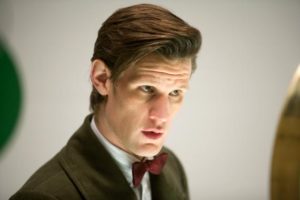 “I hate the Doctor. I hate him more than I have ever hated anyone in my life.”
Despite not being the focus of this story, Matt Smith brings the comedic Doctor to the forefront in a time of ever present danger. One word from Amy stands out: hate; Old Amy uses it to guilt the Doctor. Somehow Matt displays this perplexed Doctor, baffled at the remarks made by his best friend, while still portraying the funny, conscientious being we’ve all come to love. “And there he is. The voice of god” It seems nonsensical to view the Doctor as a god, but when you think about it, he almost is. His evolution has caused him to become an ancient, feared being.
The God Complex
 Two points: that emotional speech the Doctor gives Amy to stop her faith in him, and when he leaves her on Earth. Firstly, the concept of the story was amazing, kudos to Toby Whithouse. Honestly, Gillan and Darvill both complement Smith’s portrayal, and you realise that the reason why Smith has been able to grow in the role is due to the family spirit between the three co-stars. I’m extended an emotional ride in this episode, where little Amelia appears, and importantly, when the harsh reality hits the Doctor; there’s one particular part where Matt Smith’s eyes tell the story of sadness, the tale of the madman in a box. He is saving the Ponds by leaving them on Earth, one of the sad realities of the solemn life he lives.
Closing Time
 The episodes with Craig are generally light hearted one, not so action packed and filled with comedy. But the most dramatic scene has to be when Craig was being converted into a Cyberman. Here the Doctor is completely helpless; this shows the dangerous side of travelling with the Doctor. It can be all fun and games one moment, and all over for you the next. It would have been horrible for the Doctor to witness, one of his friends being converted into one of his most hated enemies. In this moment, he thinks that Alfie has lost his father and Sophie has lost her husband, and it’s his fault. Another death on his conscience would have destroyed him.
The Wedding of River Song
 A controversial episode to say the least. But the Eleventh Doctor’s character definitely changes in this episode. He’s still trying to run away from his death at the hands of the Silence, but it is when he learns of the Brigadier’s death that he accepts that he can’t keep running away, he has to face his death. The expression on his face keeps filling with sorrow and regret as he learns that the Brigadier died waiting for him to come and visit him. It sums up the Eleventh Doctors character; he keeps on leaving people waiting for him, Amy being the best example! Matt truly is the Doctor in this finale, on highest form.
Defining Moment
The defining moment for Matt Smith’s Doctor in Series 6 is when his dark side begins to take over in and when he apparently cheats death using the Teselecta.
Next time we take a look at the stories from Series 7. Let us know in the comments which of the Series 6 stories you think feature Matt’s hidden gem performances.