Doctor Who – “The Story & the Engine” Review – Ironically, Needs a Trim
Clint Schwalen gives his SPOILER-filled commentary on the fifth episode of Series 15.
Note: this review contains full SPOILERS for episode 5 of Series 15.
Featuring a script by Nigerian-born British playwright and poet Inua Ellams, the fifth episode of Doctor Who’s fifteenth series boasts an impressive pedigree. Unfortunately, Ellams’ strengths—particularly his experience writing for the stage and his use of mythic themes and archetypes to explore racial and sexual identity—undermine his script for “The Story & the Engine.”
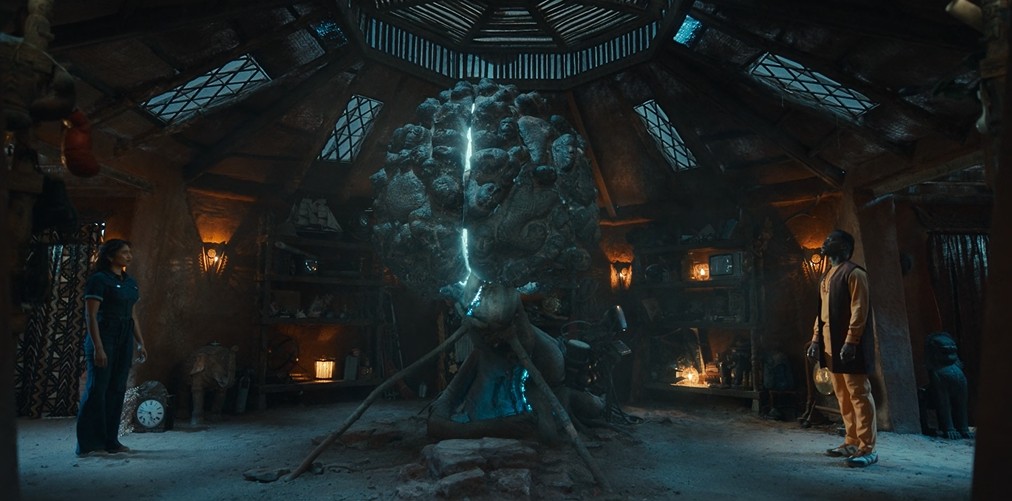
Ellams’ contributions to the stage are undeniable, with Ellams appointed a Member of the Order of the British Empire in 2023 for his body of work. Unsurprisingly, “The Story & the Engine” is structured like a short play, with the characters mostly confined to a one-room set, despite the vibrant Lagosian marketplace surrounding the barbershop. The script’s themes are complex and invite the audience to consider how knowledge and identity are shaped and shared through storytelling. While this would make for a thoughtful night at the theatre, it creates issues within the narrative, when filmed for television. For example, the Barber cutting off his own dreadlocks seems nonsensical, as his story doesn’t fuel the titular engine. The act would be effective in drawing the attention of a live audience, pulling their focus towards the character as he reveals himself to be increasingly unhinged. However, television—with its ability to control the viewpoint of the audience, focusing their attention on what the director deems most important to convey the narrative—doesn’t need to include these types of superfluous actions, and the scene feels out of place here.
More critically, Ellams’ transition from playwright to scriptwriter is hampered by the episode’s time constraint, which is unable to give Ellams’ script the space it needs to fully develop its themes. The notion that killing the mythic gods of story from various cultures would prevent humanity from passing on knowledge or preserving tradition is an interesting concept, as is the analogy of the Nexus, which “connect[s] concepts, cultures, and ideas,” being compared to a beating heart within a brain. Given 100 minutes across a two-act play, these ideas could be developed; however, due to the episode’s runtime—part of which is dedicated to furthering the series-long story arc—these ideas are barely explained, much less explored.
Nowhere is this more evident than the story’s epilogue, which is maddeningly trite and occurs only because the runtime is expiring, and not because it follows organically from the dialogue or the action. The immortal Barber will just keep cutting hair. Abena, a literal demigoddess, is free to do . . . whatever. Everyone is exceedingly happy and forgiving, despite untold years of abuse and betrayal. The scene lacks emotional resonance because no one acts in a relatable manner. The characters in “The Story & the Engine” are one-dimensional because they are written as archetypes—a feature of Ellams’ other works, particularly his book of poetry, Thirteen Fairy Negro Tales, and his play, The Half God of Rainfall. Archetypes are ciphers representing aspects of the human psyche. They are “heroic,” “maternal,” or “deep-thinking” without necessarily displaying human emotions. Note how easily characters can be reduced to their archetypes: the Barber is “the betrayed one,” Abena is “she who was scorned,” and Belinda is “the companion.” Great science fiction is defined as using its fantastical settings and futuristic technology to highlight and explore an aspect of the human condition. Because these characters are written as archetypes, they are unable to fulfill this tenet. Note, for example, how the men trapped in Omo’s barbershop are given backstories that reduce them to “the husband,” “the son,” and “the athlete,” but they lack character development or involvement within the plot.
To his credit, Ellams is thoughtful in how he uses allegory and metaphor to cover the episode’s lack of plot logic. For example, Omo’s description that the Barber “turned up one day” indicates that he has been trapped in his barbershop for so long that he no longer remembers when he became imprisoned, thus giving his story a “once upon a time” feeling. By focusing on this timeless aspect of Omo’s plight, the audience is distracted from considering how he and the other men have survived without sleeping, showering, or changing clothes.
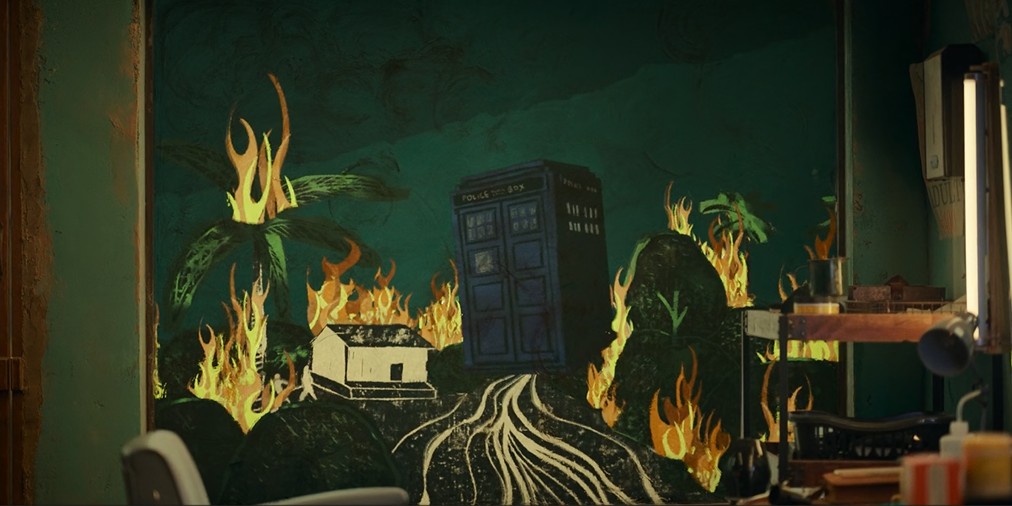
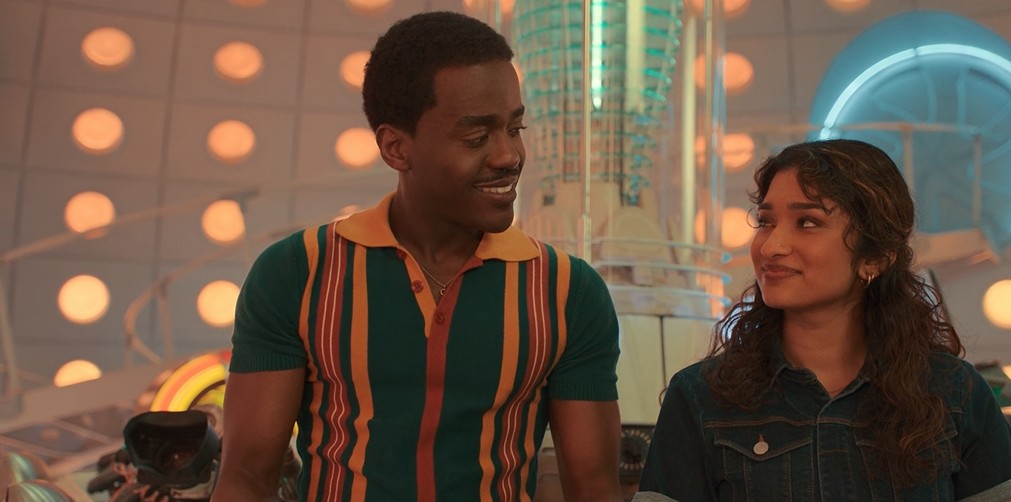
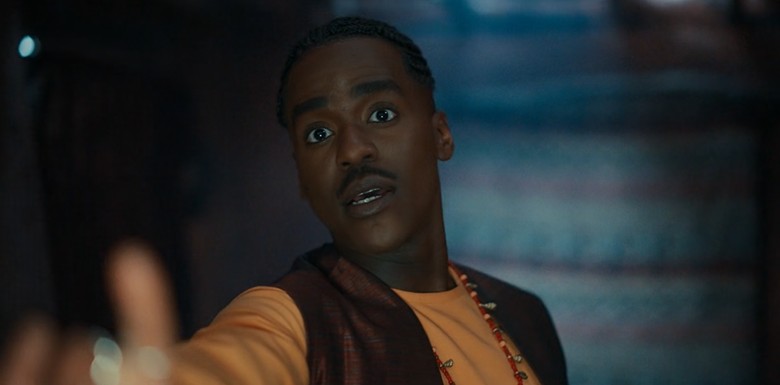
Further, the use of archetypes in “The Story & the Engine” conveys a sense of universality—cultures are unified by their collective stories—which reinforces the episode’s themes of belonging and identity. In a very sweet scene, the Doctor and Belinda bond over their shared experience of benefitting from communing with others that match their racial and ethnic backgrounds. “The Story & the Engine” makes effective use of Doctor Who’s first TARDIS team comprised entirely of persons of color, demonstrating that the show is timeless both in its sci-fi premise and its ability to adapt to its ever-changing cast. Ellams tells a story unique to this Doctor, exploring Fifteen’s identity as a Black man in a setting that celebrates his existence as such. In the episode’s most effective scene, Abena ties the Doctor’s newly braided hair into a metaphor for freedom, Black pride, and the shared values of oral tradition and community. Still, where a stage play like Regina Taylor’s Crowns has the time to develop this idea, “The Story & the Engine” can only outline the metaphor before moving on. With a longer runtime, Ellams could have further compared the isolation that Doctor experiences as a Black man to that which he feels as the last of the Time Lords. The inclusion of Jo Martin’s Fugitive Doctor practically begs the comparison—the last time the Doctor was Black, he was a fugitive. Now, he’s all alone. At Omo’s barbershop, however, he finds solace because he belongs to a community.
While Ellams’ script lacks the necessary time to develop its cast beyond archetypes, the script does include two tantalizing hints regarding the Doctor’s character. First, when the Doctor tells his preliminary story, he is already aware that Omo and the other men are being held captive by the Barber. He understands that the stories are somehow compelled by and tied to the Barber’s power, even though he doesn’t understand yet the nature of that connection. Despite initially promising a grand epic involving “Daleks, Cybermen, [and] Weeping Angels,” when forced to narrate, the Doctor describes a day in the life of his companion, Belinda. The Doctor makes the clever decision to test the Barber’s engine, feeding it a snack of a story involving the minutia of Belinda’s employment rather than filling it with a full meal of a recounted battle against the Ice Warriors. However, the plan backfires, and the Doctor’s narrative restores the engine’s power reserves, indicating that the Time Lord is incapable of seeing anyone—especially a companion like Belinda—as unimportant.
Second, the episode states that Anansi purposely lost his bet with the Doctor to force the Doctor to marry Abena, one of his daughters. However, at the time, the Doctor was a middle-aged Black woman, which begs the question: is the Fugitive Doctor gay? In “Fugitive of the Judoon,” the Doctor is married to her companion, a man named Lee Clayton, but that aspect of her identity could’ve been the result of the chameleon arch masking her true, Gallifreyan nature. Is Abena gay—the Fugitive Doctor does call her “my darling”—or was this “marriage” allegorical? If “The Story & the Engine” is meant to indicate that the Fugitive Doctor is gay, that means the last four Doctors—Thirteen, Fugitive, Fourteen, and Fifteen—have displayed some form of homosexual attraction or behavior.
Random Musings
(Time) Capsule Review
“The Story & the Engine” is hampered by its runtime, which prevents the narrative from exploring the richness of the themes introduced by its writer, playwright Inua Ellams. While Ellams’ use of archetypes excuses the episode’s lack of plot logic, the resulting one-dimensional characters fail to speak or act in a relatable manner, undermining the episode’s conclusion.
If you’d like to interact with the author of this article, follow him on BlueSky