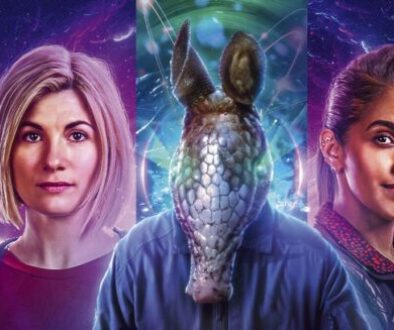
Doctor Who: “Ride Or Die” Review

Reviewed by Gustaff Behr.
Happy New Year, everyone. Let’s hope 2026 marks a return to form for Doctor Who and Britain’s favorite alien. We’re kicking off the year with “Ride or Die,” the fourth instalment in the new Thirteenth Doctor Adventure series and unfortunately, after three solid episodes, we’ve finally hit a speed bump.
To be clear, this isn’t an outright disaster on the level of some of Chris Chibnall’s most notorious efforts. “Ride or Die” is something stranger and arguably more frustrating. If I had to sum it up in a single word, it would be ‘contradictory’. It wants to be everything at once: part drama, part character study, part moral parable, and part quiet dismissal of its own moral arguments. The result is a muddle that never quite coheres.
What hurts the episode most is how heavily it leans on the overarching arc. This is easily the most arc-dependent story of the series so far, which makes it essential viewing whether it earns that importance or not. Unfortunately, the material we get rarely lives up to the weight it is supposed to carry.
The Doctor receives loads of different space-time coordinates and, suspecting a trap, travels to one with Yaz in Afghanistan, 2018, where they witness an American military vehicle disappear into an interdimensional rift. Retreating to Sheffield, 2021, they encounter another rift, which promptly swallows Yaz along with her old paramedic friend Megan.
This new, other-dimensional world is home to millions of people abducted through space-time rifts across countless centuries. To make matters worse, they are locked in a brutal war with strange creatures they cannot communicate with, beings that emit destructive sonic blasts whenever they attempt to speak.
This is where the story’s first major problem emerges. Conflicts are introduced and resolved instantly, draining them of any dramatic tension. You would expect the Doctor to spend a sizable portion of the episode investigating the rifts to locate Yaz; instead, she finds her almost immediately. Later, another character is murdered. Yaz reacts in a very human way, picking up a weapon and intending to kill the murderer, but she is swiftly talked down by the Doctor. That should be a turning point. You would expect Yaz to be shaken, or at least to question the Doctor’s increasingly reckless behavior. Instead, she moves on almost at once, shelving the trauma until the final scene, where she delivers the bad news to the victim’s family.
At first I wondered if they were even going to address the fact that this person had a family who wouldn’t know their loved one is now deceased, but then they do address it in the most self-absorbed manner. What should be a raw, emotionally devastating exchange is quickly turned into a self-focused scene, centering more on Yaz’s feelings. Worse still, much of this supposedly pivotal scene happens off-screen, robbing it of the impact it desperately needs.
For the most part, “Ride or Die” feels oddly risk-averse, and the few risks it does take come without meaningful consequences. Much of this lands at the Doctor’s feet. Jodie Whittaker herself is excellent here; there are moments where the Doctor’s writing absolutely nails who the character is and what she stands for. Her determination, her certainty, and her refusal to bend feel very Doctor-ish, and I admire the conviction with which she’s written in those scenes.
The problem is the other half of her portrayal. At one point, the Doctor deliberately releases a dangerous enemy combatant into a base full of unsuspecting personnel, trusting that a being who has spent nearly five centuries fighting its captors won’t kill anyone on the way out. She also assumes none of the unbriefed soldiers will panic and shoot this escaped creature. It’s breathtakingly reckless.
Predictably, the plan only half-works, and it costs someone their life. The Doctor absorbs this with little more than a couple of minutes of grief before everyone moves on. It’s uncomfortably reminiscent of the worst habits of the Chibnall era, where the Doctor would make morally dubious decisions and the narrative would either justify them outright or quietly ignore them. “Ride or Die” gestures at moral complexity, but it never commits to exploring the consequences, and that ultimately leaves the episode feeling hollow rather than challenging.
This is a smaller nitpick, but Yaz comes off rather poorly in this episode. When one of the people who rescues her and Megan is killed, Megan feels a genuine sense of obligation to help with the war effort against these creatures. Yaz, by contrast, immediately washes her hands of the situation. She firmly states that she isn’t a soldier, won’t pick up a weapon, and won’t fight someone else’s war.
She’s not wrong, strictly speaking, but the way the point is framed leaves a sour taste. It’s especially jarring when set against the Doctor’s own response a few scenes later. When the Doctor is blackmailed into helping with the war effort, she draws a clear moral line: she will not fight in another war, “ever again”. That said, she also makes it equally clear that this doesn’t mean she won’t help. She won’t pull a trigger, but she will still do whatever she can to bring the conflict to an end.
The contrast is stark. The Doctor comes across as morally principled and fundamentally altruistic, while Yaz reads as someone primarily concerned with saving her own skin. Even if the audience understands that this isn’t what Yaz truly means, the writing doesn’t do her any favours, and the episode never quite bridges the gap between intent and impression.
“Listen to me Yaz. Holding onto our principles is easy most days. It’s when they’re tested, like this, that they actually matter. That’s when you have to stay true to who you want to be. I’ve got to know you understand: No shot fired in anger or fear or hate is ever gonna make anything better.”
– Thirteenth Doctor
It’s not all bad. As mentioned earlier, the scene where the Doctor talks Yaz out of taking revenge is genuinely effective. Her line about how “no shot fired in anger” resonates beautifully. It’s nowhere near as lengthy or thunderous as Peter Capaldi’s anti-war speech in Series 9, but it’s delivered with such sincerity and quiet conviction that it almost works on you entirely. Almost, because it’s hard to forget that the Doctor’s own actions indirectly led to this character’s death in the first place.
Earlier in the episode, Thirteen also name drops the Geneva Convention upon discovering how the military has been treating its captives. She reminds them that the Convention doesn’t exist to guarantee fair treatment for prisoners, but to ensure that the captors themselves do not lose their humanity. It’s a strong, thoughtful point, and one delivered with real moral clarity.
These are exactly the kind of moments that were sorely lacking during much of the televised Thirteenth Doctor era: brief flashes of insight, compassion, and philosophical weight that remind you what this Doctor can be when the writing allows her to be.
As for the overarching plot, the episode reveals that a mysterious figure calling themselves “the Tourist” is deliberately orchestrating these events, sending assassins and laying traps for both the Doctor and Yaz. We’re given no insight into who they are or what they ultimately want, but with eight episodes still to go, there’s plenty of time for those answers to unfold.