Doctor Who: “The Return of the Doctor” Review – Two for Two
Reviewed by Gustaff Behr.
People often underestimate just how difficult it is to keep Doctor Who feeling fresh, or to find something truly “new” to say with a character like the Doctor. After all, this is a figure who has lived for thousands of years, taken on multiple faces, and accumulated countless experiences. The danger is that the Doctor can easily slip into being treated as a static character, with little to no room for genuine growth. The New Series worked hard to break away from that trap by giving each incarnation a distinct “journey.” The Ninth Doctor’s arc was about grappling with survivor’s guilt. The Tenth Doctor’s story explored the arrogance that came with his power, and the humbling consequences that followed. These character journeys gave their eras weight and definition, showing how even an ancient time traveler could still change.
On paper, Jodie Whittaker’s Doctor had all the makings of a similar journey, due to the Timeless Child storyline. Unfortunately, because her television run began and ended with her playing essentially the same version of the character, the space for growth is now locked down. That limitation carries over into other media, but where there’s a will, there’s a way.
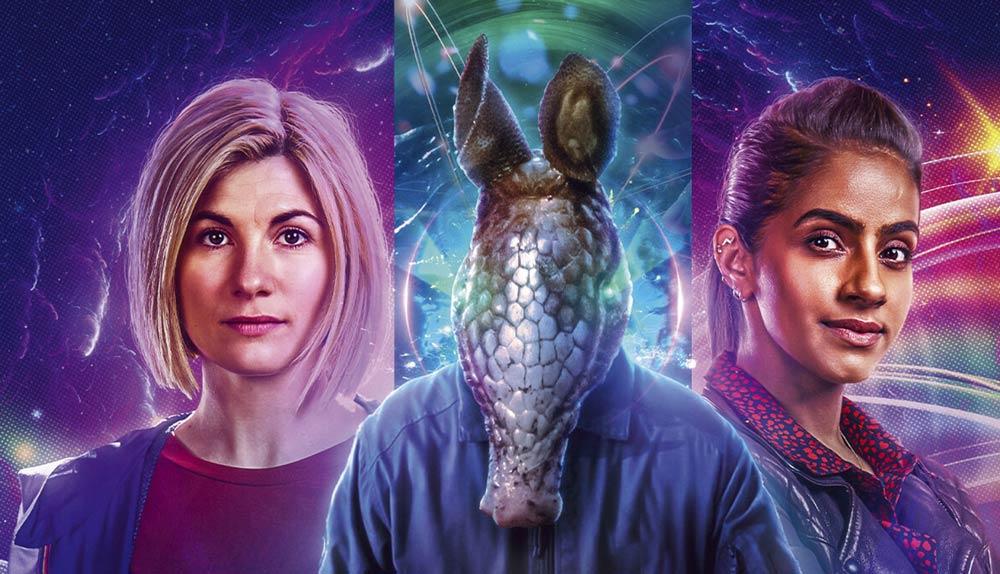
The story opens with the Doctor and Yaz rescuing the peaceful Zaarians from a fairly standard threat. In the aftermath, their guide Talpa is injured, prompting the Doctor to rush him to the hospital. She exchanges a few sharp words with the cowardly local leader, Taav, before slipping away in search of her next adventure.
It’s at this point that writer Rory Thomas-Howes poses the central question: What happens to the worlds the Doctor saves? Shouldn’t she stay behind, at least long enough to help rebuild? When is the right time to leave those who have only just survived catastrophe? Yaz argues they should remain until Talpa regains consciousness, but the Doctor insists she knows better.
To prove her wrong, Yaz sets the TARDIS to return just one week later. Instead, they arrive a decade in the future and find a world in ruins. The streets are filled with chaos and rebellion, and the citizens have only one person to blame: the Doctor.
The Return of the Doctor feels like the kind of story that should have been told much earlier and it would have fit seamlessly into the Jodie Whittaker era. By tackling the question of why the Doctor rarely returns to the worlds she’s saved, the story gives us not only meaningful development for the Thirteenth Doctor but also a multi-Doctoral commentary on her character across incarnations.
The script explores both sides of the argument in great detail. The Doctor insists it would be unfair to the wider universe if she stayed too long on any one world. Her presence risks creating dependency, with civilizations looking to her as a crutch…something Earth has arguably already done. Yaz, however, suggests that the Doctor’s reluctance is really fear: fear that all her victories amount to nothing, that her interventions might actually leave societies worse off, something that has seemingly happened with this adventure.
It’s a compelling conflict because both perspectives ring true. The Doctor is a hero with a powerful moral compass, but she is, above all else, a traveler who rarely seeks out trouble unless it finds her. Yaz, by contrast, is a police officer sworn to protect anyone and everyone, regardless of circumstance. That clash of ideologies (wanderer versus guardian) feels so natural that it’s surprising it wasn’t explored on television much sooner.
The conflict doesn’t stay confined to the Doctor and Yaz. It extends to the guest cast as well. Without diving into spoiler territory, I’ll just say that I found every guest performance engaging, even if some of the character backstories leaned a little close to familiar territory. Talpa, in particular, receives a welcome amount of focus, which goes a long way toward humanizing him and making his role in the story resonate.
The Return of the Doctor runs about ten minutes longer than a typical story, and you really feel the difference in the best way possible. The extra time allows for a well-paced narrative and space for genuinely heartwarming interactions: between the Doctor and Yaz, Yaz and Talpa, the Doctor and Talpa, and even the Doctor with the wider cast. These moments don’t just deepen the relationships, they also humanize the Doctor herself, giving her room to show real vulnerability.
The payoff comes near the end, when she delivers a powerful, emotionally charged speech, followed by a raw and intimate exchange with Yaz. A few clever twists along the way even had me bracing for a Fearmonger-style (an early Seventh Doctor classic) resolution, only for the script to pull the rug out at just the right moment.
If there’s a flaw, it’s the opening. The first few minutes echo the clunkiest habits of the Chibnall era, heavy with exposition characters shouldn’t need to say. It’s a rocky start, but thankfully, the story quickly pivots into the more character-driven drama that sustains the episode. What follows is a character-driven drama that leans into the best aspects of the Thirteenth Doctor, giving her some much-needed development while still staying true to the socially distant persona she carried on television.
I haven’t said much about the antagonist, and that’s intentional. Part of the intrigue lies in figuring out who they are and how they connect to the larger conflict. When revealed, it’s a clever idea, but the antagonist ultimately serves more as a narrative device to seed conflict for the Doctor and Yaz rather than as a villain to be vanquished. And that’s fine; the story’s strength lies in character exploration rather than another monster-of-the-week showdown.
The Return of the Doctor is a welcome addition to the Thirteenth Doctor’s catalogue and, for the second release in a row, highlights just how much sharper Big Finish’s writing can feel compared to the TV series. Like Vampire Weekend, it’s an excellent jumping-on point for curious listeners. That said, it does lean more toward “filler” territory, since it doesn’t advance the mystery teased at the end of the previous story, nor does it introduce any obvious overarching plot threads…at least, not that I could spot.