Doctor Who: “The Interstellar Song Contest” Made My Head Hurt – 2nd Opinion, Take 2
J.C. reviews the sixth episode of Series 15.
Before watching this week’s Doctor Who, I’d just finished the eighth episode of Season 2 of Andor (I’m a bit behind and catching up), and my god, was that a bad idea. The contrast could not have been starker. Andor was serious, considered science fiction, sharply written, and beautifully acted. Its characters faced impossible choices, and the show refused to offer easy answers or fall back on black-and-white morality. What the episode built, minute by minute, was dread, a slow, suffocating tension that crept up until it finally exploded. You didn’t just watch things unfold, you felt them closing in. The action, when it came, was grounded and brutal. It was confident, grown-up storytelling, and easily some of the most powerful television I’ve seen this year. In short, it was genre TV at the peak of its craft.
And then I watched Doctor Who… I was immediately greeted by a space furry and a real-life Ken doll fresh out of cryogenic freeze, kicking off a campy song contest while silly aliens pranced about in the audience. Talk about whiplash!
“The Interstellar Song Contest” is initially set up as a Eurovision spoof in space, but it can’t seem to decide what it wants to be. One minute it’s a confetti-drenched musical extravaganza, the next it’s half-heartedly dealing with genocide, revenge, and political oppression. The simplistic plot feels stitched together from offcuts of better Doctor Who stories. The Doctor and Belinda arrive just in time for a universe-wide song contest, which is promptly hijacked by a villain named Kid, who plans to murder the audience using a psychic brainwave transmitted through the broadcast.
I was baffled to learn this was the most expensive episode of Doctor Who ever made. For me, it only fleetingly looked the part. Then again, I had just watched Andor, which wears its nearly $300 million budget a season in every frame. Perhaps Doctor Who‘s set cheapness was intentional, meant to match the Eurovision’s trashy aesthetic, but it ends up undermining the drama. That said…
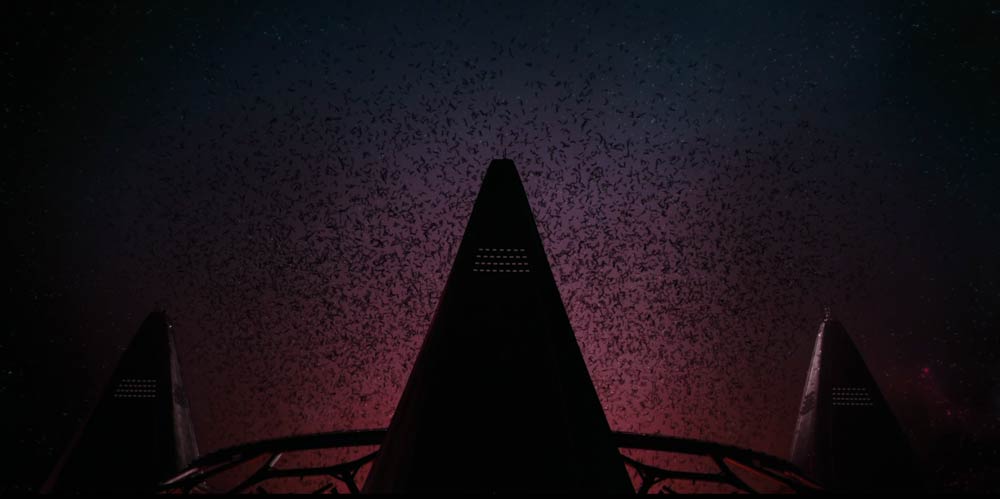
There is, however, one legitimately stunning sequence early on when the arena’s air shield collapses, blasting the audience and the Doctor into space. Kudos to the CGI artists. It was genuinely haunting as bodies slowly float away and freeze, leaving us to reflect on the apparent atrocity. For a moment, it feels like current Doctor Who might actually commit to some real stakes. But sadly, as is so often the case, the show soon walks it back. Turns out the “mavity” field has suspended them in a state of preservation (I’m so over mavity). The Doctor himself inexplicably survives thanks to a random vision of Susan (more on her later) somehow restoring him, and then launches himself back with a confetti cannon, also somehow managing to shout while he’s riding it in space. Sigh. And so what seemed like a mass genocidal attack becomes a large-scale rescue op instead.
Ncuti Gatwa feels adrift in this episode, where he’s required to juggle his usual campy, energetic self with something far darker later on. He gets his own attempt at more of a Time Lord Victorious moment when he catches up to and repeatedly tortures Kid. The scene felt unearned, arriving abruptly with little build-up. It took a lot of groundwork for David Tennant’s Doctor to reach that kind of darkness. Here, it happens in minutes. And while I appreciate a darker character turn when it’s done well, the Doctor outright repeatedly torturing someone doesn’t sit right with me. There’s a big difference between darkness and cruelty. Remember, “Never cruel or cowardly”? RTD doesn’t seem to. It’s also resolved far too quickly, with the Doctor and Belinda heading off without ever really addressing it.
Speaking of. Belinda’s given a few tender scenes and plays a key role in grounding the Doctor again, though it could have been handled better. There’s no real character growth. After spending most of the previous two episodes off-screen and spending much of this one either panicked or sidelined, she suddenly turns to the Doctor and calls him “wonderful”. This comes not long after witnessing him torture someone, which makes the emotional payoff feel hollow. Their relationship has barely been developed across this season. Her praise feels less like a genuine character moment and more like a scripted beat the show hasn’t earned.
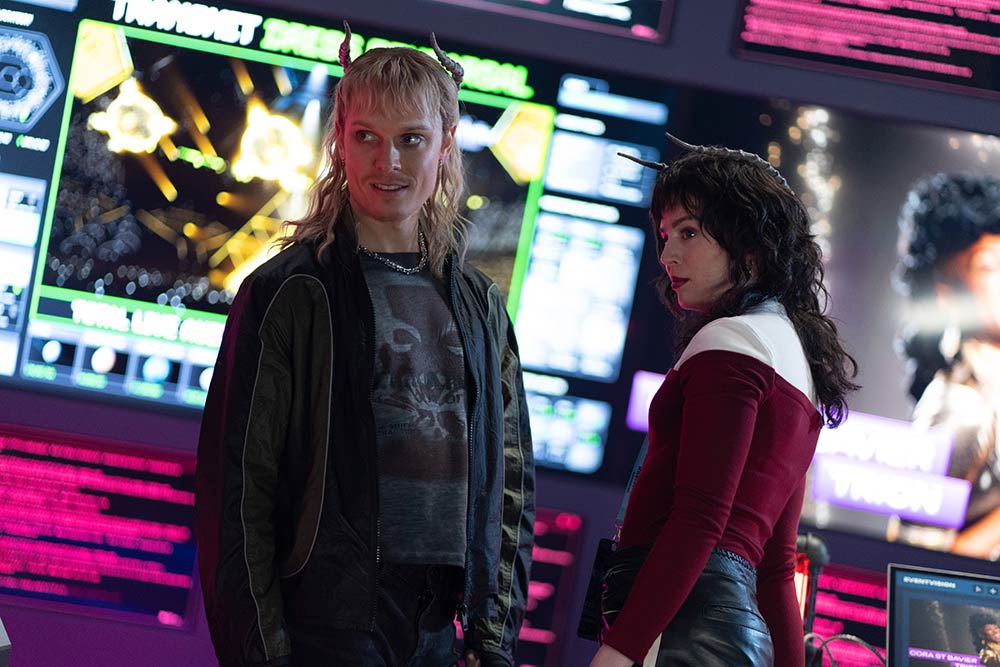
Then there’s Kid, our main villain of the week. He’s the latest in a long line of angry young men (I’m seeing a pattern here), and while his backstory has more weight than Alan or Conrad’s, it’s still too little, too late. We learn that his planet, the inventively named Hellia, was destroyed by corporate greed, harvested, stripped, and left barren for the sake of honey flavouring. That’s a disturbing concept, and his desire for revenge could have made him a more sympathetic figure. But instead of exploring that with nuance, the show plays it big and broad. His plan to hijack the broadcast and kill three trillion viewers with a psychic brainwave is cartoonishly over the top, and the script never gives him the depth or internal conflict needed to make it land. The show gestures at systemic critique, but ends up falling back on familiar clichés, the damaged outcast with a grudge, lashing out at the galaxy. With more time and stronger writing, Kid could have been an interesting antagonist.
Surrounding the Doctor is a rotating cast of guest stars. Rylan Clark plays a heightened version of himself, not much of a stretch, but Graham Norton rather surprisingly delivers as a hologram version. Miriam-Teak Lee as Cora is also decent. Her final performance, a ballad from her lost homeworld, isn’t bad and almost justifies her arc. But even that is nearly drowned out by the constant tonal zig-zagging. The show never lets any emotion settle any more. The gay couple, Mike and Gary, seem to be there to mostly resolve plot points all too conveniently. They just happen to have the exact skills needed to save the day, one’s a nurse, the other a hologram technician with expert knowledge of triangulation. The Doctor himself jokes about how convenient it all is, but pointing out the issue doesn’t make it go away.
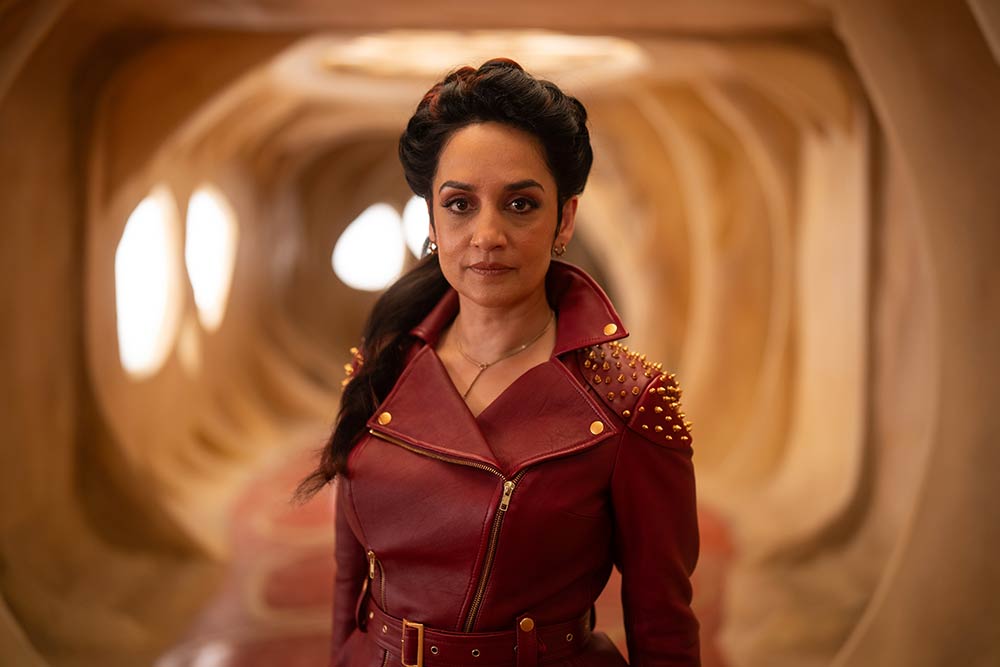
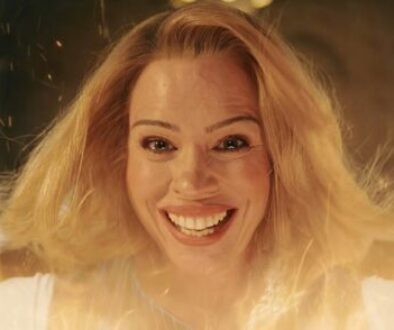
Just when it seems like the story has wrapped up, we get one last twist, the Rani is back. Or rather, two Ranis. I doubt this reveal landed as big as RTD hoped, with rumours swirling for months. And it’s another bi-generation already. So much for this “mythical” event. The reveal itself lacks tension or mystique (and with a rather cheap-looking effect too). It’s thrown in as if trying to mimic a Marvel-style mid-credits teaser, instead of building toward it masterfully in the episode like with past major villain reveals. Also, Anita Dobson’s character hasn’t acted remotely like the Rani up to this point. It feels like RTD retrofitting the name onto Mrs Flood rather than planning it from the start. And Flood-Rani’s suddenly all subservient? Why?
There’s also a bigger question: is the Rani’s return even necessary at this point? Missy already explored the idea of a female Time Lord antagonist in a layered, memorable way. This Rani seems like she’ll continue to be a pantomime villain (admittedly, it’s early days, so I can only hope there’s more to it). Also, now that gender fluidity is standard for Time Lords, the idea of a “Time Lady” villain doesn’t feel especially relevant now. If anything, it raises a fair question, would they ever make the Rani a man now? Or does it only work one way?
Finally, there’s Susan. Her brief appearance as some sort of vision is undeniably pleasing, a callback many fans have waited decades to see. But it’s little more than a cameo. After being teased throughout Series 14, her return finally happens here, randomly, and with no real narrative weight. If RTD was able to get Carole Ann Ford back all along, why not use her in the 60th anniversary specials, where it would have made far more historical sense? Instead, her reappearance is cryptic, fleeting, and sadly underwhelming (for now).
“The Interstellar Song Contest” wants to be a lot of things, a love letter to Eurovision, a satire of corporate greed, a tragic fable of lost worlds, but in trying to be all of them at once, it ends up being none of them. It’s loud, messy, and emotionally scattered. What should be a symphony of genres ends up as little more than noise.